
Papier mâché botanical model, made by the Robert Brendel Company
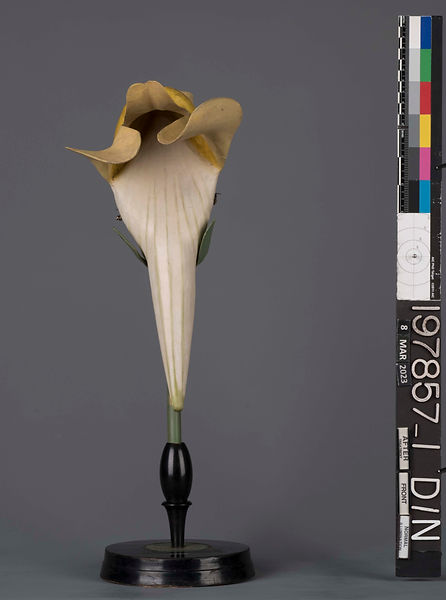
Owned by the Buffalo Museum of Science, this papier mâché botanical model made in the 19th century by the Robert Brendel company was in many dissociated pieces at the start of treatment. Using living specimens of the flower after which the model was designed, Linaria vulgaris (yellow toadflax, or commonly, butter and eggs) I was able to put the parts together and replicate missing elements.
Before treatment photography
This image was captured by Buffalo State University graduate Rio Lopez, who also completed preliminary surface cleaning of the object before it fell into my care.

Field research
On a tip from the technician at the Buffalo State University Eckert Herbarium, I drove to a local nature preserve to see if I could forage a living specimen of Linaria vulgaris, noted to grow in the Western New York area from mid-summer to mid-autumn. I found several flowers and took a stem back to the conservation lab where I dissected the blooms under a microscope, and captured the following images of the internal anatomy.


Images of the dissociated flower anatomy compared to the pieces of the model.

Repair of breaks, reattachment of loose parts
The structure of the papier mâché involved a fabric armature coated with a chalky plaster material and a final layer of paint. The stem was a painted, sculpted wooden dowel, and some of the reproductive organs were made of wood as well with additional metal wire internal supports. The plaster coat had cracked in many places, the fabric armature keeping the broken bits from falling off entirely. Both the breaks and the dissociated elements were repaired with Lascaux 498, after consolidating any cracked or powdery edges with Lascaux medium for consolidation. The mends were set to dry in a tub of glass beads, clamped with hair clips.


Fills and inpainting
A series of combinations of filling compounds and inpainting media were tested before application to the object. In the image to the left (seen below this text when viewing this website on mobile), Flügger fills have been tested on the left tongue depressor, and a mixture of cellulose powder and Jade 403 have been tested on the right. I also learned how to spell gouache. Finally.
Ultimately, cellulose power and Jade was chosen as the fill material for losses on the papier mâché elements due to its flexibility, and Flügger was chosen to fill losses on the wooden stem due to its ability to be neatly leveled and smoothed. QoR watercolors were chosen as the inpainting medium for their gloss level and opacity control.
In the right image (seen above this text when viewing this website on mobile), the same general area of loss to the wooden stem is seen after being filled with Flügger (left), and after inpainting with QoR watercolors (right).
Any areas of high gloss were matted down using dabs of soft wax and clean, warm hands manipulation.


Creation of missing parts
Using my photomicrographs of the living flower's reproductive organs, a replica stamen was modeled from polymer clay. A silicone mold was created, and a mixture of cellulose powder and Jade 403 was pressed into it. The first few test casts lacked structure, and so a stainless steel wire core was introduced between the two mold halves to provide support.
The cast was allowed to full dry before it was smoothed and built out to match the extant stamen using wet cellulose powder and Jade 403 on top of the dry surface. It was then painted with Golden fluid acrylics and adhered to the model along with the other detached stamen.


Fabrication of missing hook closure
This model would have been handled and interacted with: the front face of the flower removed to inspect the anatomy within. To promote this interaction, two copper alloy hook and clasp systems keep the model closed at the sides. One of these hooks was lost, and I was able to replicate the existing hook and mirror it to complete the mechanism.
I pierced the new hook out of 20 gauge red brass sheet, sanded and filed its edges smooth, and used a liver of sulfur patina to apply a dark base layer of color before applying Golden Fluid acrylics to match the patina of the extant hook. The image below shows the new hook (left) compared to the extant hook (right, attached to the object).


After treatment photographs
Below are the before treatment and after treatment images shown side by side.



The UV-A visible fluorescence image captured a great map of the restoration materials, which are all shown as black, non-fluorescent areas (see the seam along the top of the main flower component where the petals extend backwards, and the right replacement stamen).
