Analysis of samples from the St. Mary, a 19th century shipwreck at the Maine State Museum
I worked at the Maine State Museum in the summer of 2022, supervised by Teresa Myers, objects conservator. Among many other activities in my three months at the museum, I examined the St. Mary, a shipwreck fragment on permanent exhibit. I returned to Buffalo in the fall with samples to analyze with the help of Dr. Aaron Shugar.
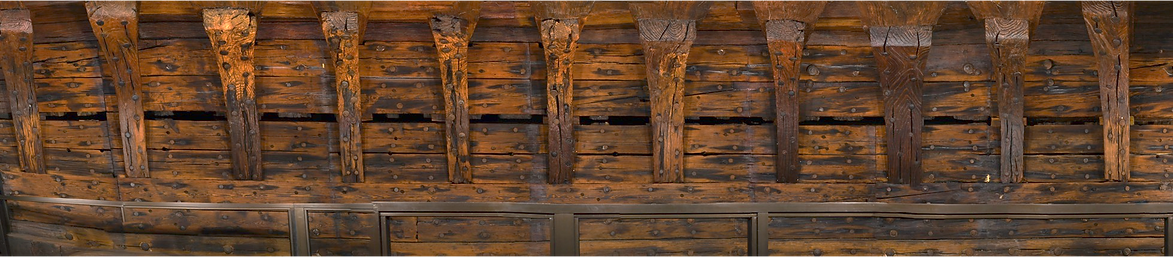
The St. Mary was a “Downeaster” merchant ship built in Phippsburg, Maine in 1890. She was wrecked on the Falkland Islands during her maiden voyage that year, and a 40-foot ‘tween deck section was salvaged in 1978 by a crew headed by Peter Throckmorton, marine archaeologist, and Eric Berryman, retired Navy commander, and logistics director of the salvage operation. The wreck was disassembled on the Falkland beaches via chainsaw, and transported back to Augusta, first making a pit stop in the UK by way of a British military ship, and then back to Maine. The wreck remains were acquired by the Maine State Museum in Augusta, Maine for an exhibit on shipbuilding. The above image is a digitally stitched panorama of the exhibit.

The St. Mary in the beginning
She was one of the last "Downeaster" wooden merchant ships ever built. Here she is docked and ready for her maiden voyage, which would be her last.
The St. Mary pre-salvage
The St. Mary was re-discovered on a 1976 trip to survey the wrecks on the Falkland Islands, spearheaded by Peter Throckmorton, a marine archaeologist. This is what she looked like when she was found by Throckmorton and his team: home to many sea birds, including a local colony of gentoo penguins. She was cut apart by chainsaws and loaded onto a ship that would take her to the UK where she would eventually be picked up by a US Navy training ship and brought home to Maine.


The St. Mary now
The preservation and installation of the St. Mary was sadly underdocumented. The museum has very little information about how the ship section was taken from half-buried wreck to polished museum installation.
The images below all capture the most concerning condition issue of the St. Mary: the white crystal-like blooms growing across her wooden surfaces. The main goal of my sample collecting and analysis was to characterize these blooms.


Many samples were collected, and their locations documented on a digital map, seen below. Solvent tests on the overpaint found throughout the exhibit were completed at the same time as sample collection, and also recorded on the map.

Back in Buffalo, FTIR analysis was performed as a first step to establish a plan for further instrumental analysis. The results are recorded in the table below.

From the FTIR, Dr. Aaron Shugar and I headed to the XRF. Analysis of the same samples returned results consistent with the FTIR results, along with elements like bromine and strontium which are commonly associated with sea water. Iron was also detected in many samples.
Our last course of instrumental analysis was the Scanning electron microscope /
electron dispersive x-ray spectrometer (SEM/EDX). Several samples were prepared for analysis, and micrographs and spectra were captured. Results returned evidence of sulfur as well as chlorine and iron.
Sulfur is likely present in the samples from the St. Mary from elemental sulfur in seawater, as well as oxygen scavenging, sulfur depositing bacteria which attacked her timbers at the time of her half-burial. These embedded organo-sulfur compounds can react with iron degradation products from the ship’s hardware and, in the presence of oxygen, can catalyze the oxidation of sulfides into sulfates. We know that the St. Mary is offgasing sulfur-related compounds through a 2021 study done where water samples from dehumidifiers across the museum were analyzed. The amount of sulfates retained in dehumidifiers in proximity to the St. Mary was nearly 70% higher than in dehumidifiers throughout the building.

This image was taken of a sample of the white crystal substance. The plate-like inclusion within the web of salt crystals is made of iron.
This image is an elemental map generated via EDS of the same sample as above, and at the same location at a slightly different scale and position. The iron inclusion is clearly highlighted in green and yellow, while the ammonium chloride salt is in red and pink.

Ultimately, I was not able to identify the white crystal blooms past ammonium chloride with iron inclusions. A few theories for the presence of this compound throughout the timbers of the ship include the wreck's environmental exposure to ammonium-rich bird waste, or application of a biocidal agent following initial salvage.
A full report-style writeup of my analysis and conclusions is available upon request. Contact me!