
Research and Analysis of a Victorian-era taxidermy bird life group
Taxidermy was once at the height of Victorian fashion, from decorating one's domestic environment to accessorizing hats. The object at the center of this thesis tells the story of this trend as a symbol of scientific fascination and aesthetic fixation. The summary of my analysis found on this website only scratches the surface of the work I completed as a part of my thesis. The full paper can be downloaded here. To visit the webpage on this object's treatment, click here.

The object at the center of my thesis: a Victorian-era bird group from the Buffalo Museum of Science
Taxidermy was very much in fashion during the Victorian era, and people from all socioeconomic classes wanted to participate in the phenomenon. Owning taxidermy was a way to invite the natural world into the home, and to celebrate intellectualism and world exploration from the comfort of the parlor.
Pretty and conveniently-sized life groups like my thesis object were things of beauty and badges of sophistication. Many were produced by master taxidermists; the same people stuffing lions and elephants for museums of natural history. Others were made by amateurs: hobbyists with strong stomachs and a desire for nature craft. Another class of taxidermy décor was that of the commercially-made, which I believe to be the source of the object at the center of my thesis.

The taxidermist (amateur or seasoned) could source supplies and skins from the local naturalist shop. You can see the glass domes on display in the window here. (Image above via https://www.dailymail.co.uk/)

The taxidermist would need a wide range of tools, as depicted here on a plate from Artistic and Scientific Taxidermy and Modelling, published in 1894. These include feather pliers for arranging the feathers, a “crowder” for placing the stuffing, an eye/brain scoop (self explanatory), as well as needles, awls, files, and brushes.

Outlined here in red is an entry advertising "shaded goods" in a catalog of the 19th century home furnishings company Silber and Fleming. This was the only source of commercially-made taxidermy goods that I could identify during the course of my research.
I was guided to this catalog by Mr. John Whitenight, avid collector of and expert on domed Victorian decor. He provided me advice on my thesis object, pointing out multiple indications of it's commercially-made status such as the use of garish colors on the rock work, faux branches instead of real twigs, and the inclusion of many relatively common bird species, not to mention the overall sub-par craftsmanship that would never be seen leaving the bench of a professional taxidermist.
Now that we've covered some historical context, let's move on to analysis!

Analysis began with X-ray fluorescence spectroscopy to make sure the object was safe to bring into the conservation department from its home at the Buffalo Museum of Science.
With help of Dr. Aaron Shugar, heavy metal pesticides were identified, but the levels were determined low enough for the object to be brought into the department, with the provision that safe handling practices be undertaken.
Read a bit about health and safety regarding my thesis treatment here.
In the spectrum on the right (below this text when this website is viewed on mobile), you can see that the XRF returned results for arsenic and mercury, two common ingredients in the preservatives most often used by 19th century taxidermists.
The image below the spectra is a recipe for preservative paste taken from a Victorian-era taxidermy manual, listing both arsenic and mercury (corrosive sublimate) as ingredients.
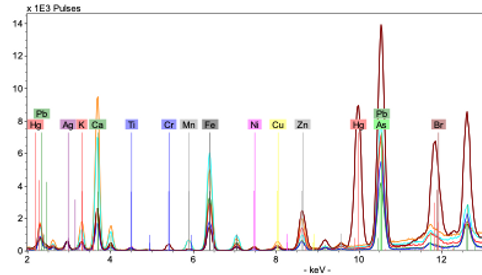

The spectra below, representing scans of the green and red pigments on the object, show elements characteristic with several pigments mentioned in Victorian taxidermy manuals. Both emerald green and red lead were recommended by multiple manuals for inclusion in a taxidermist's supply kit.


More information on my analysis and results can be found in my full thesis paper. It can be downloaded here.