
Victorian-era taxidermy bird life group
This object, owned by the Buffalo Museum of Science, is a decorative piece that was made to grace the mantles of the Victorian home. It would have originally been displayed with a fitted glass cloche for protection, but that component has long been lost. The bird species are mainly from South and Central America, with the bottom-most black bird being native to Asia. The page of this website devoted to research and analysis can be found here. My full thesis on the research and treatment of this object can be downloaded here.


Before treatment images
Note the overall dullness of the birds due to accumulated dust, losses from the fan of dried grasses at the back, and the missing eyes of the green and red-headed birds.


X-radiographs
X-rays captured the inner wire armatures of the birds and the central tree structure. Certain pigments such as the red and green were observed to be radio-opaque, denoting heavier elements in their formulation. The glass eyes of each bird can be seen in the images, as well as the metal posts at the backs of the eyes which secure them into the eye sockets.
Surface cleaning

Due to the detection of arsenic and mercury during XRF spectroscopy completed before treatment began, safety precautions were taken very seriously. Work surfaces were covered in disposable materials (placed in the corresponding hazardous waste containers once soiled), and proper PPE was worn.
Cleaning began with soft brushes and a designated heavy metals HEPA-filtered vacuum. Additional feather preening was carried out using clean mascara wands and tweezers to zip feather barbs.
Feather fills and
recoloring
Research done at the American Museum of Natural History regarding feather recoloring informed my treatment material choices for this project. PanPastels were selected to color fill feathers (made from undyed, commercially-available chicken feathers) as well as to directly recolor bare patches of featherless skin on the mounts themselves.

Chicken feather barbs were gathered in small, full clumps and adhered at their bases with Lascaux 303HV. For fills needing to cover a wide surface area, the clumps of barbs were first adhered to a backing of non-woven polyester stretched in a miniature, custom-made PVC pipe embroidery hoop. The resulting patch of barbs was then cut from the polyester and adhered to the mounts using a mixture of Lascaux 303 HV and 498 HV.


Placement of feather fills in progress on a large area of loss. The left image is before fill placement, and the right is after.


Before (left) and after (right) of a PanPastel-toned feather fill in place.
Replacement parts
A replacement foot for the parrotlet was sculpted, toe by toe, from a two part epoxy putty and painted with Golden fluid acrylics. The foot was adhered to the exposed armature wire of the lost foot using Paraloid B48-N in acetone.
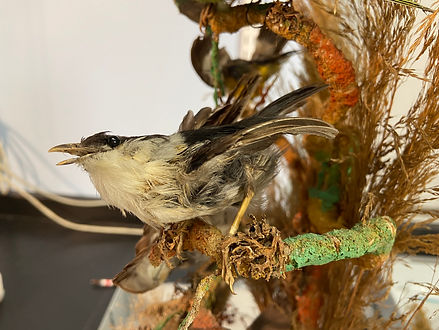
A replacement lower jaw/beak for the small brown and white bird (pictured below) was fabricated from the tip of a chicken feather rachis and adhered in place using Lascaux 498 HV. Layered strips of toned chicken feather barbs were adhered below the rachis to replace lost feathers associated with the damage to the jaw. The rachis jaw was toned using QoR watercolors.


Before (left), during (middle), and after (right) placement of a fill to the loss of the lower jaw.
Consolidation of plant material
The dried grasses present on the object were very friable and readily shed fragments during movement and handling. I acquired dried grass of a similar species and carried out consolidation tests using an airbrush, changing the polymer and solvent until I found a combination that offered ideal aesthetic and functional qualities. That combination was 12% Paraloid B72 in xylene. The B72 provided the necessary strength and appropriate gloss level while the xylene was a slow-evaporating solvent that worked well with the airbrush application.
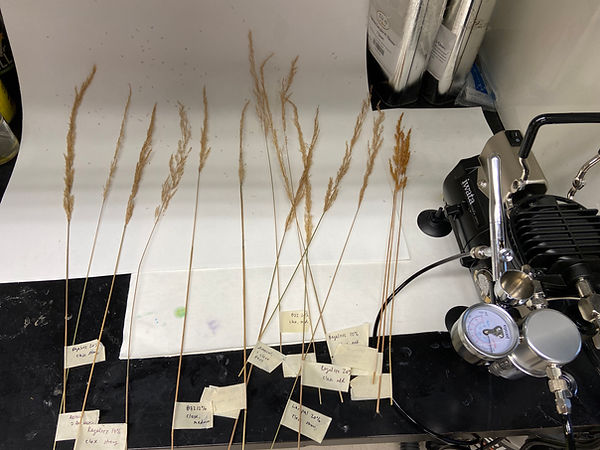

The chosen consolidant was applied to the actual object in a fume hood, using a piece of blotter to block off areas, making sure the plant material was the only element subjected to the consolidant. It was also applied to the powdery pigment on the papier mache rockwork.
Before & after treatment
Side by side before and after treatment photographs. Before treatment photos are on the left, and after are on the right.


Before treatment

After treatment

UVA image showing the optical brighteners of the chicken feather fills, making the restoration material stand out against the original object.